Podcast Feed

Monday, May 24, 2021

Dhaak : Emperor's New Clothes | राजा के नए कपड़े

Listen here: Podcast


Tonight we bring you another Dadima | दादीमाँ story. This time on popular request we chose a story that our corporate listeners would also relate to. Emperor's New Clothes is about Maharaja Batuk Lal Maurya of Shundi who was really fond of new clothes. Its his story narrated by your favorite host Tushar Sen:


Dhaak : The Matrix | मायाजाल


The matrix as we know it is all around us, we live in it and think it to be real. You have to understand. Most people are not ready to be unplugged. And many of them are so hopelessly dependent on the system that they will fight to protect it. The system is ones ego and ones ego shape our consciousness. They are fundamentally one and the same. To become unplugged implies shattering your illusive identity, the story about you and the world around you. It implies becoming face to face with reality, and thus acknowledge all the negative and positive aspects of the world around you, not only those fit to your story. Let's understand maya tonight dear listeners, my story will help you understand better. So happy listening and do share your views with me onhttps://instagram.com/tusharsarojsen ORhttp://dhaak.com

Thursday, January 17, 2008

Basic Valuation Of A Real Estate Investment Trust (REIT)


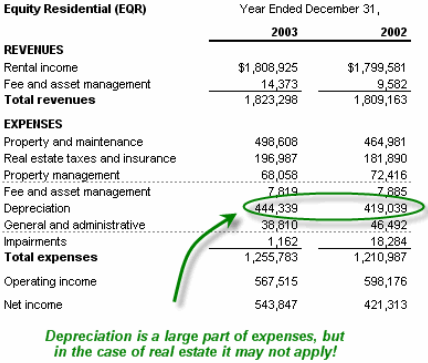
If you try to estimate the value of a real estate investment trust (REIT), you will quickly find that traditional metrics like the earnings-per-share (EPS) ratio, growth, and the price-to-earnings (P/E) multiple do not apply. In this article, we will show you how to estimate the value of an reit. Funds from Operations (FFO) Is Better than Earnings Let's start by looking at the summary income statement of the largest residential REIT, Equity Residential (ticker: EQR):


From 2002 to 2003, Equity Residential's net income, or the "bottom line," grew by almost 30% (+$122,500 to $543,847). These net income numbers, however, include depreciation expenses, which are significant line items. For most businesses, depreciation is an acceptable non-cash charge that allocates the cost of an investment made in a prior period. But real estate is different than most fixed-plant or equipment investments: property rarely loses value and often appreciates. Net income, a measure reduced by depreciation, is therefore an inferior gauge of performance. Therefore, REITs are instead judged by funds from operations (FFO), which excludes depreciation. FFO is reported in the footnotes, and companies are required to reconcile FFO and net income. The general calculation involves adding depreciation back to net income (since depreciation is not a real use of cash, as discussed in the above paragraph) and subtracting the gains on the sales of depreciable property. These gains are subtracted because we assume that they are not recurring and therefore do not contribute to the sustainable dividend-paying capacity of the REIT. Below we show this reconciliation of net income to FFO (with a few minor items removed for the sake of clarity) for 2002 and 2003:


We can see that, after depreciation is added back and property gains are subtracted, funds from operations (FFO) equals about $838,390 in 2002 and almost $758,000 in 2003. FFO must be reported, and it is widely used, but it contains a weakness: it does not deduct for capital expenditures required to maintain the existing portfolio of properties. Shareholders' real estate holdings must be maintained (for example, apartments must be painted), so FFO is not quite the true residual cash flow remaining after all expenses and expenditures. In estimating the value of an reit, professional analysts therefore use a measure called "adjusted funds from operations" (AFFO). Although FFO is commonly used, professionals tend to focus on AFFO for two reasons. One, it is a more precise measure of residual cash flow available to shareholders and therefore a better "base number" for estimating value (for example, applying a multiple or discounting a future stream of AFFO). Two, because it is true residual cash flow, it is a better predictor of the REIT's future capacity to pay dividends. AFFO does not have a uniform definition. However, the most important adjustment made to calculate it is the subtraction of capital expenditures, as mentioned above. In the case of Equity Residential, almost $182,000 is subtracted from FFO to get AFFO for the year 2003. This number was taken directly from the cash flow statement. We use it as an estimate of the cash required to maintain existing properties, although we could try to make a better estimate by going to the trouble of looking at the specific properties in the REIT. Look for Growth in FFO and/or AFFO Once we have the FFO and the AFFO, we can try to estimate the value of the REIT. The key assumption here is the expected growth in FFO or AFFO. This involves taking a careful look at the underlying prospects of the REIT and its sector. The specifics of evaluating an reit's growth prospects are beyond the scope of this article, but, in general, these are the sources to consider:
Prospects for rent increases
Prospects to improve/maintain occupancy rates
A specific plan to upgrade/upscale properties - A popular and successful tactic is to acquire "low-end" properties and upgrade them to attract a higher quality tenant. Often a virtuous cycle ensues. Better tenants lead to higher occupancy rates (fewer evictions) and higher rents.
External growth prospects - Many REITs favor fostering FFO growth through acquisition, but it's easier said than done. An REIT must distribute most of its profits and therefore does not have a lot of excess capital to deploy. Many REITs, however, successfully prune their portfolios: they sell underperforming properties to finance the acquisition of undervalued properties. Apply a Multiple to FFO/AFFO The total return on an reit investment comes from two sources: (1) dividends paid and (2) price appreciation. We can break down the expected price appreciation into two components: 1. Growth in FFO/AFFO 2. Expansion in the price-to-FFO or price-to-AFFO multiple Let's look at the multiples for EQR below. Note that we are showing "price ÷ FFO" which is really 'market capitalization ÷ FFO', and EQR's market capitalization (number of shares multiplied by price per share) in this example is about $8 billion.

Aside from making a direct comparison to industry peers, how can we interpret these multiples? Like interpreting P/E multiples, interpreting price-to-FFO or price-to-AFFO multiples is not an exact science, and the multiples will vary with market conditions and specific REIT sub-sectors (for example, apartments, offices, industrial). As with other stocks, we want to avoid buying into a multiple that is too high. But remember that, aside from the important dividends paid, any price appreciation breaks down into two sources: growth in FFO/AFFO and/or expansion in the valuation multiple (price-to-FFO or price-to-AFFO ratio). If we are looking at an reit with favorable FFO growth prospects, we should consider both sources together. If FFO grows at 10%, for example, and the multiple of 10.55x is maintained, then the price will grow 10%. But if the multiple expands about 5% to 11x, then our price appreciation will be approximately 15% (10% FFO growth + 5% multiple expansion)!
A useful exercise is to take the reciprocal of the price-to-AFFO multiple: 1 ÷ [Price/AFFO] = AFFO/Price. In the case of EQR, this equals about 7.2% ($575.7 ÷ 8,000). This is called the "AFFO yield." To evaluate the price of the REIT, we can then compare the AFFO yield to (1) the market's going capitalization rate, or "cap rate," and (2) our estimate for the REIT's growth in FFO/AFFO. The cap rate is a general market-based number that tells you how much the market is currently paying for real estate. For example, 8% implies that investors are generally paying about 12.5 times (1 ÷ 8%) the net operating income (NOI) of each individual real estate property. Let's assume that we determine the market's cap rate is about 7% and that, further, our growth expectation for EQR's FFO/AFFO is a heady 5%. Given a calculated AFFO yield of 7.2%, we are probably looking at a good investment: our price is reasonable when compared to the market's cap rate (it's even a little higher, which is better), and, even more promising, the growth we are expecting should translate into both higher dividends and price in the future. In fact, if all other investors already agreed with us, the price of EQR would be higher because it would need a higher multiple to impound these growth expectations. One final note: we ignored debt in this illustration. Essentially, we assumed that EQR's debt burden is modest and "in line" with the industry peers. If EQR's leverage (debt-to-equity or debt-to-total capital) were above average, we would need to consider the extra risk implied by the additional debt. Summary When evaluating REITs, we get a clearer picture by looking at funds from operations (FFO) rather than looking at net income. If we are seriously considering the investment, we should try to calculate adjusted funds from operations (AFFO), which deducts the likely expenditures necessary to maintain the real estate portfolio. AFFO is also a good measure of the REIT's dividend-paying capacity. Finally, the ratio price-to-AFFO and the AFFO yield (AFFO/price) are tools for analyzing an reit: look for a reasonable multiple combined with good prospects for growth in the underlying AFFO.

What Are REITs

A real estate investment trust (REIT) is a real estate company that offers common shares to the public. In this way, a REIT stock is similar to any other stock that represents ownership in an operating business. But a REIT has two unique features: its primary business is managing groups of income-producing properties and it must distribute most of its profits as dividends. Here we take a look at REITs, their characteristics and how they are analyzed.The REIT StatusTo qualify as a REIT with the IRS, a real estate company must agree to pay out in dividends at least 90% of its taxable profit (and fulfill additional but less important requirements). By having REIT status, a company avoids corporate income tax. A regular corporation makes a profit and pays taxes on the entire profits, and then decides how to allocate its after-tax profits between dividends and reinvestment; but a REIT simply distributes all or almost all of its profits and gets to skip the taxation.
Types of REITsFewer than 10% of REITs fall into a special class called mortgage REITs. These REITs make loans secured by real estate, but they do not generally own or operate real estate. Mortgage REITs require special analysis. They are finance companies that use several hedging instruments to manage their interest rate exposure. We will not consider them here. While a handful of hybrid REITs run both real estate operations and transact in mortgage loans, most REITs focus on the 'hard asset' business of real estate operations. These are called equity REITs. When you read about REITs, you are usually reading about equity REITs. Equity REITs tend to specialize in owning certain building types such as apartments, regional malls, office buildings or lodging facilities. Some are diversified and some are specialized, meaning they defy classification - such as, for example, a REIT that owns golf courses.What Kind of Asset Is a REIT Stock?REITs are dividend-paying stocks that focus on real estate. If you seek income, you would consider them along with high-yield bond funds and dividend paying stocks. Consider the last 20 years of returns for the NAREIT Equity REIT Index (an index of about 150 traded REITs), shown below. The red bars represent annual returns solely from dividends; they have averaged about 8% and never once fallen below 4.8%. The blue bars add price changes for each year - they represent total return, price change plus income return. You can see that stable dividends combine with price volatility to create a total return which is often promising, but volatile nonetheless.


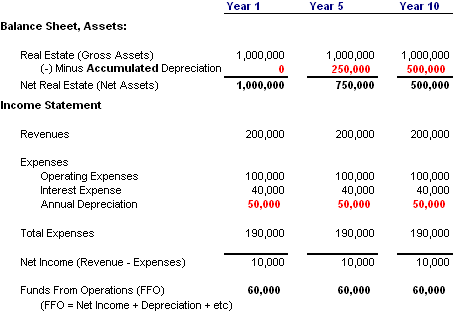
Analyzing REITsAs dividend-paying stocks, REITs are analyzed much like other stocks. But there are some large differences due to the accounting treatment of property. Let's illustrate with a simplified example. Say a REIT buys a building for $1 million. Accounting requires that our REIT charge depreciation against the asset. Let's assume that we spread the depreciation over 20 years in a straight-line. Each year we will deduct $50,000 in depreciation expense ($50,000 per year x 20 years = $1 million).


Let's look at the simplified balance sheet and income statement above. In year 10, our balance sheet carries the value of the building at $500,000 (a.k.a., the book value): the original 'historical cost' of $1 million minus $500,000 accumulated depreciation (10 years x $50,000 per year). Our income statement deducts $190,000 of expenses from $200,000 in revenues, but $50,000 of the expense is a depreciation charge.But our REIT doesn't actually spend this money in year 10; depreciation is a 'non-cash charge'. Therefore, we add back the depreciation charge to net income in order to produce funds from operations (FFO). The idea is that depreciation unfairly reduces our net income because our building probably didn't lose half its value over the last 10 years. FFO fixes this presumed distortion by excluding the depreciation charge. (FFO includes a few other adjustments, too.)We should note that FFO gets closer to cash flow than net income, but it does not capture cash flow. Mainly, notice in the example above that we never counted the $1 million spent to acquire the building (the capital expenditure). A more accurate analysis would incorporate capital expenditures. Counting capital expenditures gives a figure known as adjusted FFO, but there is no universal consensus regarding its calculation.Our hypothetical balance sheet can help us understand the other common REIT metric: net asset value (NAV). In year 10, the book value of our building was only $500,000 because half of the original cost was depreciated. So, book value and related ratios like price-to-book - often dubious in regard to general equities analysis - are pretty much useless for REITs. NAV attempts to replace book value of property with a better estimate of market value. Calculating NAV requires a somewhat subject appraisal of the REIT's holdings. In the above example, we see the building generates $100,000 in operating income ($200,000 in revenues minus $100,000 in operating expenses). One method would be to 'capitalize' the operating income based on a market rate. If we think the market's present cap rate for this type of building is 8%, then our estimate of the building's value becomes $1,250,000 ($100,000 in operating income / 8% cap rate = $1,250,000). This market value estimate replaces the book value of the building. We then would deduct the mortgage debt (not shown) to get net asset value. Assets minus debt equals equity, where the 'net' in NAV means net of debt. The final step is to divide NAV into common shares to get NAV per share, which is an estimate of intrinsic value. In theory, the quoted share price should not stray too far from the NAV per share.

Other ConsiderationsWhen picking stocks, you sometimes hear of top-down versus bottom-up analysis. Top-down starts with an economic perspective and bets on themes or sectors (for example, an aging demographic may favor drug companies). Bottom-up focuses on the fundamentals of specific companies. REIT stocks clearly require both top-down and bottom-up analysis.From a top-down perspective, REITs can be affected by anything that impacts the supply of and demand for property. Population and job growth tend to be favorable for all REIT types. Interest rates are, in brief, a mixed bag. A rise in interest rates usually signifies an improving economy, which is good for REITs as people are spending and businesses are renting more space. Rising interest rates tend to be good for apartment REITs as people prefer to remain renters rather than purchase new homes. On the other hand, REITs can often take advantage of lower interest rates by reducing their interest expense and thereby increasing their profitability. Capital market conditions are also important, namely the institutional demand for REIT equities. In the short run, this demand can overwhelm fundamentals. For example, REIT stocks did quite well in 2001 and the first half of 2002 despite lackluster fundamentals, because money was flowing into the entire asset class.At the individual REIT level, you want to see strong prospects for growth in revenue, such as rental income and related service income, and FFO. You want to see if the REIT has a unique strategy for improving occupancy and raising its rents. REITs typically seek growth through acquisitions, and further aim to realize economies of scale by assimilating inefficiently run properties. Economies of scale would be realized by a reduction in operating expenses as a percentage of revenue. But acquisitions are a double-edged sword. If a REIT cannot improve occupancy rates and/or raise rents, it may be forced into ill-considered acquisitions in order to fuel growth. As mortgage debt plays a big role in equity value, it is worth looking at the balance sheet. Some recommend looking at leverage, such as the debt-to-equity ration. But, in practice, it is difficult to tell when leverage has become excessive. It is more important to weigh the proportion of fixed versus floating-rate debt. In the current low interest rate environment, a REIT that uses only floating-rate debt will be hurt if interest rates rise.ConclusionREITs are real estate companies that must payout high dividends in order to enjoy the tax benefits of REIT status. Stable income that can exceed Treasury yields combines with price volatility to offer a total return potential that rivals small capitalization stocks. Analyzing a REIT requires understanding the accounting distortions caused by depreciation and paying careful attention to macroeconomic influences.